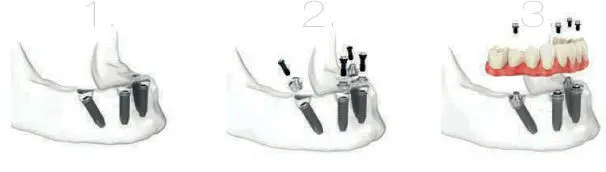
The number of dental implants to be placed depends on the prosthetic and surgical treatment plan after a thorough clinical and paraclinical /radiographic/ analysis.
At first glance, the number of implants should correspond to the number of extracted teeth. This is not always rational. We will look at four of the most common cases.
- For one extracted tooth, one implant is most often placed – this is done for incisors, canines and premolars. This is not always the case with molars. Our own molars are – the lower with two roots and the upper with three roots. This is how our molars are anatomically arranged, because the greatest forces are concentrated on them when chewing and crushing food. In this case, we want to replace two or three roots of one tooth with one implant. In a large number of cases, this is appropriate, but what happens if the tooth is very large – the distance between adjacent teeth is greater than 14 mm. There is a possibility that, as a result of the large chewing forces, the bone around the implant will be overloaded, a chronic inflammatory process will appear /with additionally superimposed bacterial invasion/ and the implant will gradually be eliminated. In this case, at a distance greater than 14 mm, we say that two implants should be placed, prosthetics with two crowns of the size of premolar teeth.
- With two adjacent extracted molars, it is logical to place two implants. However, for a distance greater than 28 mm between the teeth limiting the defect, three implants must be placed and prosthetics must be performed with three crowns.
All this is done in order to keep the bone around the implants from being overloaded and to increase their “survival”.
- The question is logical, can a bridge be placed with a larger number of extracted teeth on two implants? It is possible, with three extracted teeth, to place two implants, but the main factors on which their number depends must be taken into account:
1. size of the defect – in case of a larger defect, more number of dental implants
2. inclination of the implants – with a greater slope, more number of implants
3. diameter of the implants – for thicker bone, larger diameter implants
- length of implants – for greater bone height, longer dental implants
5. bone structure and quality
With four extracted teeth, the use of two implants is too risky, even with the best anatomical and structural conditions on the bone side.
4. How many dental implants can we treat with when all the teeth have been extracted?
– when we want to restore 14 teeth, 8 implants are needed.
– when we want to restore 12 teeth, 6 implants are needed.
– with the All-on-4 method we restore 10 teeth initially with a temporary structure, and after 4-6 months 12 teeth on the 4 dental implant.
The problem presented in such a simple way is considered and studied by dentists in depth at an academic level, but this is their duty.
The discussed issues are related to the late success rate and “survivability” of dental implants in implant-prosthetic treatment, in already osseointegrated implants.