
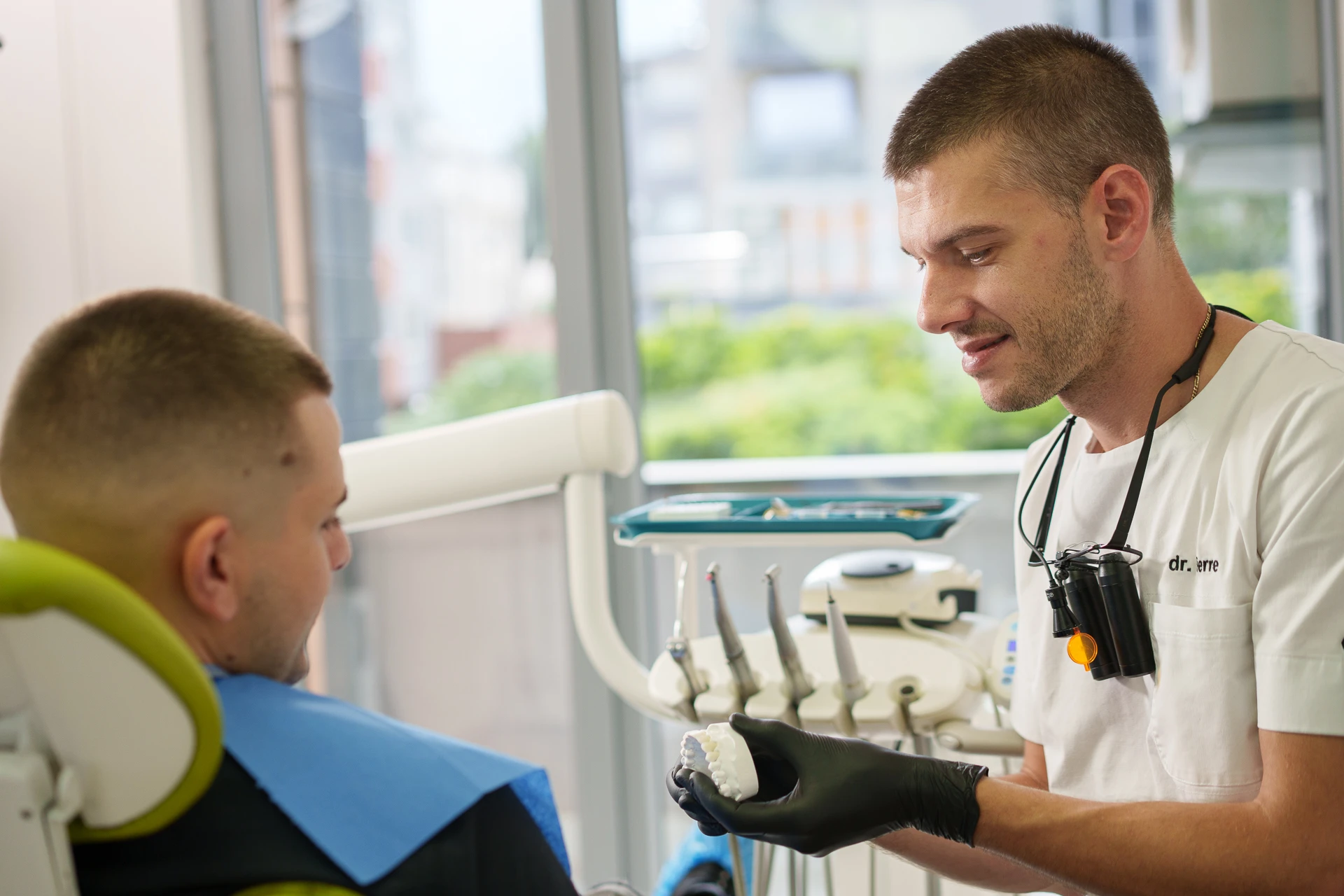
Who can perform treatment with dental implants?
Where should I be treated – in which dental clinic or office?
Is there a good dentist there, a dentist – a good implantologist?
I want the best implantologist to treat me with dental implants!
- Can I also be treated with dental implants?
- What are my chances of success with dental implant treatment?
- Can I get quality treatment in Sofia?
The answer to your questions is complicated for objective and subjective reasons. Dental implantology is an innovative discipline for the restoration of teeth lost for various reasons.
Dental implantology has an interdisciplinary nature and requires extensive and in-depth knowledge in all areas of dental medicine – surgery, periodontology, prosthetics.
The main problem is. Which is the leading?
1. surgery – placing dental implants, or
2. prosthetics – it completes the treatment with dental prosthetic structures / crowns, bridges, removable prostheses / on dental implants.
In our opinion, the question of which implantologist is the best is unknowingly misleading, because two main options are possible:
- a good surgeon but a poor prosthetist
- a good prosthetist but a poor surgeon
- In creating the project for your treatment, the prosthetist plays a leading role. He draws up the prosthetic treatment plan. It mainly depends on where to place the implants and how many there are. However, this moment must also be agreed with the surgeon regarding the anatomical features of the bone, the thickness and length of the dental implants and the inclination of their placement, i.e. the two must work in close collaboration with each other.
- If the dentist is one and is perfect in this part of the treatment /prosthetics/, but is a weak surgeon, then you will end up in option 2 – /probability of – problems in the early stages of the treatment/.
– If you have found a good surgeon who will perform prosthetics in the future, he will surely place the implants well. In more complex prosthetic situations, however, if he is not familiar with the basic principles and rules of prosthetics, lacks a prosthetic concept, then with some well-placed implants, very serious disappointments can occur at a later stage. There is a separate question about the perfection and the method of the prosthetics itself with crowns or bridges /cementable or screw-retained/. In this case, you fall into option 1 – /probability of problems in the late stages of treatment or after years/.
What you need to do is:
– or to find a dentist who is perfect both as a surgeon and as a prosthodontist
– or find a team to work in close collaboration
What the person you have chosen as your healer or a team of healers must do is to answer the question – “how far are my or our possibilities?”. He should correctly tell you at what point a problem may appear /of course if he knows/ and how it should be solved. It is necessary to assess the various risks. Know that the assessment is always subjective! It is correct on his part to refer you to a colleague with greater experience, or to suggest that the treatment be carried out by a team of specialists who are in close coordination with each other – the best for you.
In order to help you, we will ask you a few questions.
– Is it possible for a dentist to be good in all specialties and constantly maintain the necessary professional level everywhere?
– If he claims to be the best in all disciplines and wants only him to heal you “from end to end”, is that logical?
– Did you consider who /relative, friend, dental doctor/ referred you to the specialist and what is the probability that they will unknowingly mislead you? – With a recommendation from another dentist, the probability of finding a new, good healer is greater.
– Did you gather enough information and from how many sources?
- Have you inquired about the postgraduate qualification of your future healer?
- Were you invited to a preview?
- How much time did they give you and did they answer all your questions?
- Did they make a prosthetic and surgical treatment plan.
- Have they made a long-term prognosis in dental implant treatment and under what conditions can this prognosis be realized?
We have correctly tried to give you basic guidelines, to consider where to be treated if you want your future treatment with dental implants to be long-lasting, modern, prophylactic, functional and aesthetic.
The choice is yours!


