Short answer: A dental implant is the permanent solution to a missing tooth — a titanium root on which a crown is placed, indistinguishable from a natural tooth. Whether you are a suitable candidate and what the price will be is determined only after an individual examination, because every case is different. The conditions of the place where the implant is placed are different for different people.
Who is suitable for a dental implant and who is not?
Most adults in good general health are suitable candidates. The implant integrates with the bone — so sufficient bone volume is the key condition. In case of bone deficiency, all is not lost: in many cases bone augmentation is done before or during placement.
Patients are suitable who:
- have stable general health and good oral hygiene
- have stopped growing (usually after age 18)
- do not have uncontrolled diabetes or autoimmune diseases
- do not smoke or are ready to temporarily stop (smoking reduces the success rate by about 15%)
More careful judgment is required in:
- active periodontal disease (must be treated first)
- taking bisphosphonates (medicines for osteoporosis)
- radiation therapy to the head and neck in the past
Important: No one can tell you whether you are a suitable candidate over the phone or from a photo. A clinical examination with 3D imaging (CBCT scanner) is needed to assess the actual condition of the bone and gums.
How does dental implant placement work step by step?
The process doesn’t happen overnight—and that’s okay. Rushing implants is a recipe for failure. Different methods for placing dental implants can be used in planning according to the specific clinical case.
- Initial examination and diagnosis
Evaluation of the oral cavity, X-ray and 3D diagnostics, discussion of the treatment plan. At Denta Consult, this consultation costs €60 and includes a correct answer — even if the answer is “an implant is not for you right now”. - Preparation (if needed)
Treatment of caries, periodontopathies or bone augmentation. Skipping this step is a common cause of implant failure from “cheap” clinics. - Surgical placement of the implant
It is performed under local anaesthesia. The procedure itself lasts 30–90 minutes, depending on the complexity. In certain cases, digital planning and dental implant surgical guides allow for more precise positioning. The pain after the intervention is comparable to that after tooth extraction in a very small number of cases. In 90% of cases there is no pain. - Ossointegration — 3 to 6 months
The titanium root fuses with the bone. It is a biological process that cannot be sped up. For smokers or compromised health, the period may be longer. - Placing the crown
After successful integration, an impression is taken and the final crown is made. The result: a tooth that looks, functions and cleans like a natural.
General Time Frame: The entire process from review to completed implant takes an average of 4-8 months.
How much does a dental implant cost in Bulgaria and what does the price depend on?
The direct answer: between 1,200 and 2,500+ euros for one implant with a crown in Bulgaria — depending on the implant brand, the necessary additional procedures and the clinic. For a more detailed explanation, see also what does the cost of a dental implant depend on.
| Factor | Price impact |
|---|---|
| Implant brand (Straumann, Nobel, Osstem…) | Significantly |
| Need for bone augmentation | +500–1,500 euros |
| Crown type (zirconia, metal-ceramic) | Moderately |
| Number of implants | Lower unit cost |
| Preliminary treatment (gums, caries) | Individually |
Caution: If a clinic gives you a final amount before they have seen your bone scan – either they are offering the best case scenario or they are not including something in the price. Realistic: for a complete case with multiple implants, the amount can reach 5,000–15,000 euros. An individualized treatment plan is not a luxury—it’s the only way to know the real number.
Dental implant or bridge — which decision is right for you?
Both are valid solutions. The choice depends on the specific situation, not on fashion or price.
A dental implant is a better choice when:
- adjacent teeth are healthy (should not be processed for a bridge)
- you have enough bone or are ready for augmentation
- you’re looking for a permanent solution—well-maintained and hygienic implants last 20–30+ years
- missing more than 1–2 adjacent teeth
A bridge may be more suitable when:
- the adjacent teeth already have crowns or are severely decayed
- budget or health does not permit surgery
- a quick solution is needed (bridge treatment is done in weeks, not months)
The numbers speak for themselves: Studies show a 95-98% implant success rate after 10 years in properly selected and treated patients. Bridges have an average lifespan of 10–15 years and when replaced affect the adjacent teeth again.
No solution is universal. The only way to know what is right for you is after an examination with 3D diagnostics and a proper conversation with a doctor who is not out to sell a specific procedure.
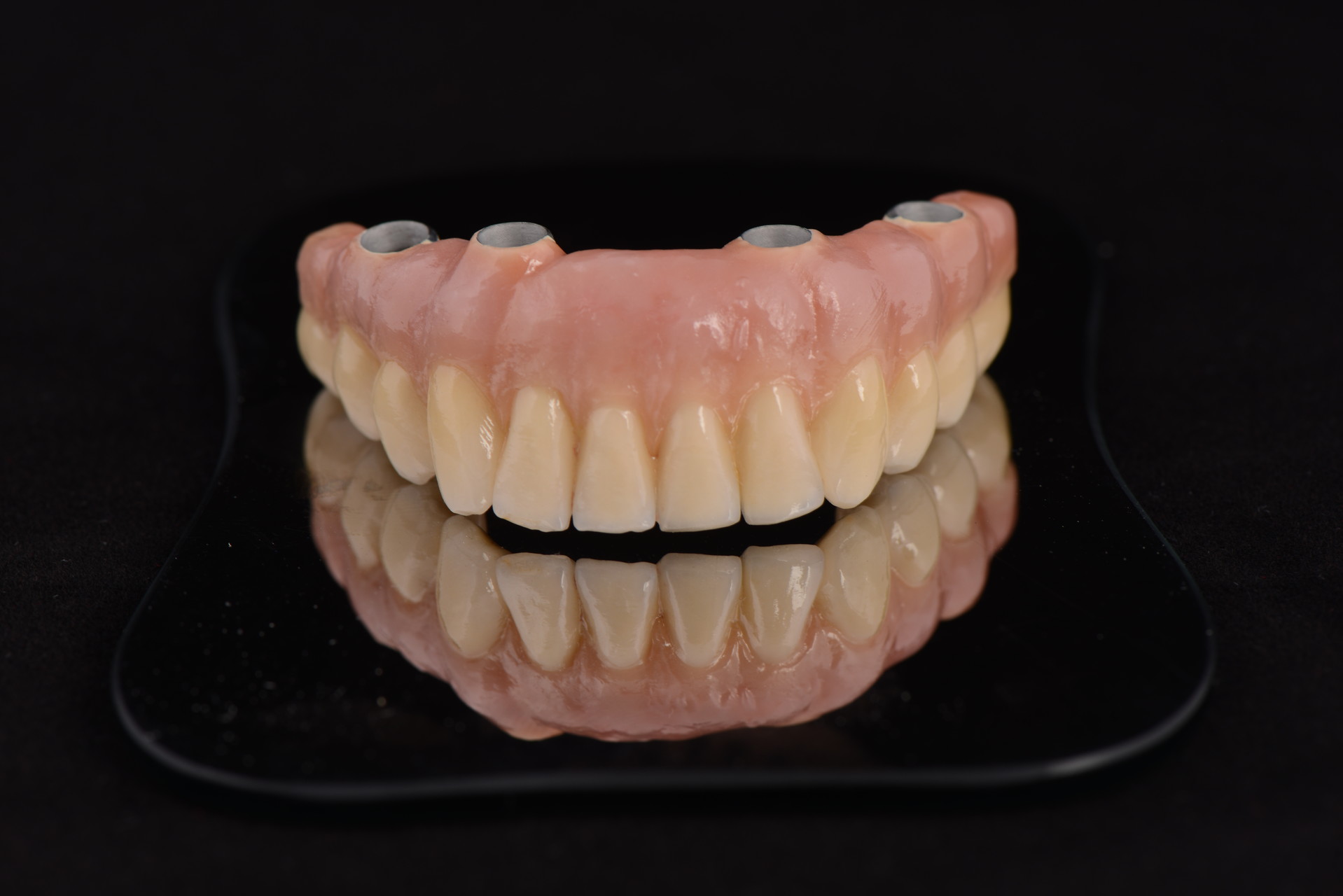
When all or nearly all teeth in one jaw are missing, single implants are not the only option. In certain cases, treatment of the entire dental arch using All-on-4 can be discussed.
Frequently Asked Questions About Dental Implants
Does dental implant placement hurt?
The procedure itself takes place under local anaesthesia and you should not feel pain during it. After the anaesthesia wears off, it is normal to have discomfort and swelling sometimes /in rare cases/ for 2-4 days, comparable to that after a tooth extraction. Most patients cope with common over-the-counter pain relievers. In case of severe or prolonged pain after the third day, contact the clinic.
How long does a dental implant last?
With proper oral hygiene and regular preventive examinations (twice a year), implants can last a lifetime. The crown on the implant is usually replaced after 15–20 years due to normal wear and tear. The main risk factors for earlier failure are: smoking, uncontrolled diabetes and poor oral hygiene.
Can I get an implant the same day I have my tooth extracted?
In certain cases, yes. This is called an “immediate implant” and is possible when the bone around the extracted tooth is in good condition and free of infection. It is not suitable for every case and the decision is made by the doctor during the examination, not beforehand. You can read more about the different approaches on the implantation methods page.
Why do prices vary so much between clinics?
The differences come from: the brand of the implant (global brands vs low quality manufacturers), the steps included or excluded from the offer, the experience of the surgeon and the equipment used. An implant for 500 euros and an implant for 1,800 euros are not the same thing — the difference is in the brand of the company and the risk of complications. Before choosing, ask what the brand of the implant is and what exactly is included in the price plus the need for additional procedures.
Do you have questions about your specific case?
Make an appointment for an initial examination at Denta Consult. The examination costs 60 euros and includes a correct and professional assessment of your situation — without obligation to continue treatment with us.