The correct use of dental implants in periodontal diseases – periodontitis, /”periodontosis” – outdated and incorrect name of the disease/ is one of the most difficult problems to solve in dental implantology. It is not just about replacing a single tooth with a dental implant or treating with a larger number of dental implants, but about assessing the volume and quality of the bone around the remaining natural teeth and how chewing forces will affect both them and the dental implants. It should be known that the assessment is always in relation to the bone around the implants and not in relation to the implants or teeth themselves. When the periodontium /the complex of tissues surrounding the teeth/ is preserved and healthy, prosthetic and surgical planning is significantly easier. Planning for damaged periodontium to varying degrees is significantly more difficult, it depends mainly on the clinical experience and knowledge of the dental implantologist. The risks of the dentist making a mistake are significant.
The treatments are different. They start by placing single implants. They go through independent splinting of a group or groups of remaining natural teeth and independent splinting of dental implants with a small amount of bone. Of utmost importance for long-term success is the continuous periodontal prophylaxis of the remaining natural teeth, the so-called clinical oral hygiene /COH/ or “tartar cleaning” carried out periodically by the dentist. The period for KOH is from 2 weeks to 6 months. Clinical oral hygiene /COH/ is extremely important to prevent transmission of infection from bone and soft tissues around one’s natural teeth to bone and soft tissues around dental implants.
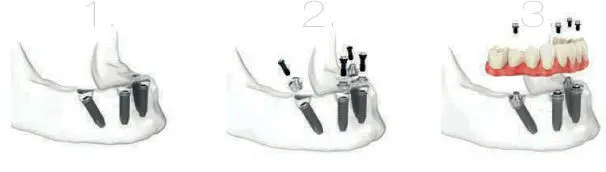
It is possible that the dental implantologist determines that it is imperative to extract all the remaining teeth and place a removable prosthesis on 2-4 dental implants or a horseshoe bridge on 6-8 implants. In this case, dental implants serve to retain it. Large horseshoe bridges can be cemented or screw-retained onto the implants. Current technology is CAD/CAM with screw fixation. In all cases, a comprehensive treatment concept is needed. The All-on-4 technique is often applicable when it is necessary to extract all remaining available teeth.
Now something very important!!!
Modern dental implantology has changed the concept of teeth. Before we used to say – “save your teeth until the end”. This was logical because we used them to hold various types of prosthetic structures. This passive approach inevitably leads to large bone losses. As a result, the placement of dental implants in the edentulous areas is very difficult or impossible. The new concept, the new view on the problem of “when to extract teeth”, is already earlier extraction, measures to preserve the bone, etc. bone augmentation and placement of dental implants, consistent with proper prosthetic and surgical planning.
Which of the two concepts will be applied depends on many factors, including the financial side of the treatment. Each case must be considered strictly individually. There should be no pattern and unification. In one case, the concept of saving the teeth until last will be correct, and in another, their earlier extraction and placement of implants.
Here we can help you with our more than 35 years of knowledge and experience, as well as with the proven global developments we apply – All-on-4 of Nobel Biocare.
In view of both concepts, we will offer you several alternative treatment options, we will discuss them together and you will decidehow to treat you.