Which dental implant placement method is best for me?
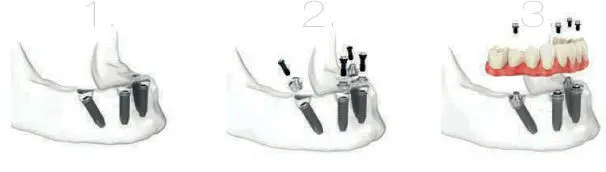
1. Covered implant method– teeth are extracted at least two months before dental implants are placed. After implantation, the dental implants remain hidden, “buried” under the mucous membrane and are not visible until the completion of the osseointegration processes between implants and bone. Covered implantation is always performed with a flap – cut and prepared mucosa. After placing the implants, the mucosa is sutured. Four months later, the dental implants are revealed through a new surgical intervention. Sulcus formers are placed – abutments for shaping the soft tissues. The sulcus formers are removed after about 10-12 days. In the covered implantation method, factory-made, standard sulcus formers are used. Treatment can be finalized:
– with subsequent screwing of the abutments / abutments to the dental implants. Crowns and bridges are cemented to the abutments in the patient’s mouth.
– with screwing of the abutment-crown complex. They are pre-cemented outside the patient’s mouth.
Cemented crowns and bridges in the patient’s mouth have a number of disadvantages.
The modern method of prosthetics is for crowns and bridges to be screw-retained.
Advantages:
- Precision and security regarding the placement of dental implants – good visual control.
- Maximum security for the occurrence of osseointegration processes between dental implants and bone.
Disadvantages:
- Operative intervention is comparatively more traumatic.
- It often happens after the operation, in the following days there is swelling, pain and unpleasant sensations. They can be prevented by prior premedication / taking medicines prescribed by the dentist/.
- Need for a second, smaller surgery to expose the implants.
2. Open implantation method– teeth are extracted at least two months before dental implants are placed. Time is needed for soft tissue to heal. The sulcusformers /temporary elements that shape the soft tissues until they heal/ are placed immediately after placing the implants. They pass through the mucous membrane and are visible from the first day. Open implantation can be of two types:
-No flap – transgingival. It is seamless. Using a machine tool, a small opening is made through the lining of the jaw and dental implants are inserted into the bone through it. A sulcusformer is placed on top.
– With a flap – the mucosa is prepared and after placing the dental implant, a sulcusformer is placed on the implant. The mucosa is sutured around the sulcusformer.
Advantages:
- In the open transgingival flapless placement of dental implants, only one mild and gentle surgical intervention is required. After the operation, there is no sign of swelling in the following days. There is no pain, no unpleasant sensations – as if nothing happened. The nutrition of the bone is not disturbed.
- When placing with a flap /preparation of the mucous membrane/ we have a good visual control over the bone for placement of dental implants. This is the more secure method of correctly placing the implants. Soft tissue grafts can always be made with this method.
Disadvantages:
- The transgingival method without a flap is risky with insufficient bone volume. Additional bone and soft tissue augmentation techniques cannot be applied to it. In the transgingival method without a flap with a zamba, soft tissues are removed, which are particularly important for the aesthetics and long-term success of treatment with dental implants.
- In open flap placement, the operation is more extensive and always ends with suture placement.
3. Method of immediate /immediate/ implantation – in principle, it is open implantation. Immediately after tooth extraction, dental implants are placed. Temporary crowns can be placed over the dental implants in the front areas of the mouth until osseointegration of the dental implants and soft tissue healing occurs. Placing temporary crowns in the back of the jaws is not recommended. It is not recommended to place permanent crowns immediately after placing the dental implants, because it takes at least 2 months for the soft tissues to form.
Advantages:
- Overall shortening of treatment time.
- You come with a tooth /teeth/ and immediately leave with a tooth – a temporary crown.
- The nutrition of the bone is not disturbed. Reduction of resorptive and atrophic processes in the bone /maximum preserved volume/ after placement of dental implants.
- Preservation of the soft tissues and hence the aesthetics of front teeth through temporary crowns.
Disadvantages:
- Risk of inaccurate 3D positioning of the implant with insufficient experience of the implantologist.
- There is often a need to use bone substitute grafts.
4. Additional surgical techniques can be added to these basic dental implant placement methods, which we use daily in our practice in the absence of sufficient volume of bone and soft tissues.
They are:
- Bone substitute grafts – bone grafts. When the volume of the bone is smaller, a procedure is performed to thicken it – bone augmentation. It can be done before or together with the placement of the dental implant.
- Soft tissue grafts. They are placed if the soft tissues are judged to be small in volume. Soft tissue grafts to augment the soft tissues over dental implants can be done at the same time as the implants are placed or in the phase of their exposure.
- Manual method of bone expansion in open and covered implantation.
- Piezo-surgical method of bone expansion in covered implantation using bone substitute grafts.
- Methods of sinus lifting – lateral and crestal.
- There are two options for lateral sinus lifting – with or without placement of dental implants. Which of the two options will be preferred depends on whether it is possible to ensure the initial /initial/ stability of the dental implants. If dental implants are possible, the operation is one. If it is decided that dental implants should not be placed immediately, there are two operations.
- With a crestal sinus lift, a dental implant is always placed. A crestal sinus lift can be with or without a bone substitute graft. A variant of the crestal sinus lift is the so-called hydro-pneumatic sinus lift.
The use of different surgical techniques expands the indications for the use of dental implants.
The knowledge and application of various methods and techniques by the implantologist increases the possibility that you will be treated qualitatively with the help of dental implants.
The fact that there are a large number of methods and techniques for placing dental implants, in itself says that there are no universal methods and additional techniques that can be said to be the best.
The assessment of what surgical methodology will be applied, what additional techniques will be used in the surgical procedures – operations for placing dental implants is only for the dentist, depending on his knowledge, capabilities and always in favor of the patient.