“All-on-4 is a very useful method in carefully selected cases, but it is not a universal solution for everyone who has dental problems or has lost their teeth.” Dr. Asen Marinov Sr. All-on-4 is suitable when all or nearly all the teeth in one jaw are missing, the remaining teeth cannot be preserved, and there is enough bone for four implants to support a fixed full-arch bridge. Whether the method is suitable for an individual patient is determined after a clinical examination and 3D imaging of the bone. In this article, I explain what we assess before recommending All-on-4 and when we prefer another solution. We describe the method itself and the treatment process step by step on the page All-on-4 in Sofia: full-arch restoration.
Who is a suitable candidate for All-on-4?
A suitable candidate for All-on-4 is someone who needs an entire dental arch restored and whose anatomy allows four implants to support a full-arch bridge. Most often, these are people who:
- have lost all or nearly all their teeth in one or both jaws;
- have remaining teeth with a poor prognosis, such as severely loose teeth affected by advanced periodontitis, which cannot be preserved;
- wear removable dentures and are looking for a fixed solution;
- have reduced bone volume in the posterior regions but enough bone at the front to allow the posterior implants to be placed at an angle;
- want to avoid extensive bone grafting – a sinus lift in the upper jaw or vertical augmentation in the lower jaw.
What do we assess before recommending All-on-4?
Before deciding on All-on-4, we assess the patient’s bone, health, natural teeth and expectations. This takes place during a clinical consultation and following 3D imaging.
The bone
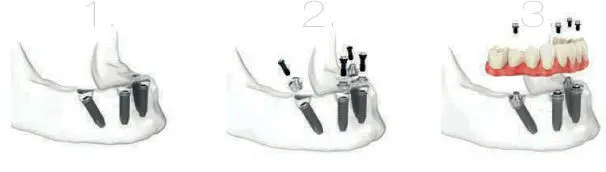
3D imaging (CBCT) shows how much bone is available in the front of the upper or lower jaw, its density and the location of important anatomical structures. With All-on-4, the two front implants are placed vertically, while the two posterior implants are angled at approximately 30–35 degrees. This makes use of the available bone at the front and, in many cases, avoids bone grafting in the posterior regions. If there is insufficient bone at the front as well, the method may not be suitable without additional preparation.
General health
We ask about medical conditions, medications and habits. Relevant factors include diabetes and how well it is controlled, the use of certain medications such as bisphosphonates, systemic conditions and smoking. We also ask about allergies. These do not necessarily rule out treatment, but they affect the risk and sometimes the plan. We discuss diabetes in detail in the article Dental implants for patients with diabetes.
Natural teeth
Wherever possible, we preserve natural teeth. We therefore first assess whether the remaining teeth can be treated and which prosthetic restorations they could support. All-on-4 is an option considered after assessment and discussion with the patient, once all alternatives have been explained.
The gums and oral hygiene
In patients with periodontitis, inflammation must be brought under control through professional oral hygiene treatment before teeth are extracted and implants placed. We also discuss how the patient will clean the restoration, because maintenance continues for years after treatment.
Expectations
I ask patients what they expect: how much time they can set aside, what concerns them and what they have tried so far. “Teeth in a day” does not mean that the entire treatment starts and finishes in one day. A temporary fixed restoration may be fitted shortly after surgery (within one to three days) if the implants have the required primary stability. The final restoration is fabricated after approximately 4 to 6 months, once the implants have bonded securely with the bone through osseointegration.
When is All-on-4 unsuitable?
All-on-4 is unsuitable or is not our first choice in the following cases:
- The natural teeth can be preserved. We then treat them and replace missing teeth with individual implants supporting crowns or bridges.
- Only a few teeth are missing. Individual implants, a bridge or crowns then offer a less extensive intervention.
- There is insufficient bone even for tilted implants. We then discuss bone grafting or another solution.
- The patient’s general health does not currently allow surgery. The condition is stabilised first, after which we return to the plan.
- Patients have taken bisphosphonates for a long time.
- The patient cannot maintain oral hygiene and attend follow-up appointments. A fixed restoration requires regular care.
What are the alternatives to All-on-4?
| Solution | When we consider it |
|---|---|
| All-on-6 | When the bone allows six implants and we want more support points for the restoration. |
| Individual implants, crowns and bridges | When only some teeth are missing or some natural teeth can be preserved. |
| A magnet-retained denture on natural tooth roots | When symmetrically positioned roots can be preserved and implants are not possible. |
| A denture retained by a bar or attachments allowing three degrees of freedom of movement | When symmetrically positioned canine teeth have been preserved. |
| A complete denture | When implants are not possible for medical or other reasons. |
You can read more about magnet-retained dentures in the article Magnet-retained dentures on natural tooth roots, and about the different types of dentures in the article Dentures.
How do we make the decision together with the patient?
I would not want a patient to arrive already convinced that they need a specific procedure simply because they have seen a persuasive advertisement. It is better to come with the question: “What are the options in my case?” That is where a meaningful conversation can begin. During the consultation, I explain what I see, the available options, the advantages and limitations of each, and why I would recommend a particular approach. In every case, we arrange a second visit after specialised examinations, including 3D CBCT imaging, after which the initial strategy may be confirmed or changed.
| Two people may arrive with seemingly similar problems and receive different treatment plans. |
Frequently asked questions
Is there an age limit for All-on-4?
The decision depends more on bone and general health than on age. That is why we pay particular attention to medical conditions and medications in older patients.
Can I have All-on-4 if I smoke?
Smoking increases the risk of implants failing to bond properly with the bone and impairs healing. We discuss this openly during the consultation before making a decision.
Can I have All-on-4 in just one jaw?
Yes. All-on-4 is planned separately for each jaw, according to its condition.
How can you find out whether All-on-4 is right for you?
If you would like to know whether All-on-4 is suitable for you or whether another solution is available, a clinical consultation at Denta Consult lasts a full 60 minutes. During this time, we assess your teeth and bone and explain the options, including their duration and cost. We explain the specific next steps. If you have a recent panoramic X-ray, bring it with you; if not, one can be taken on site.