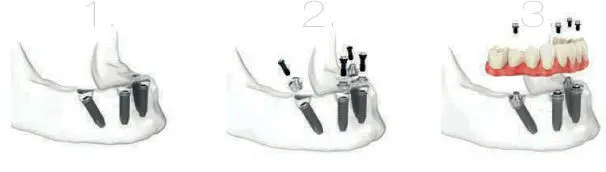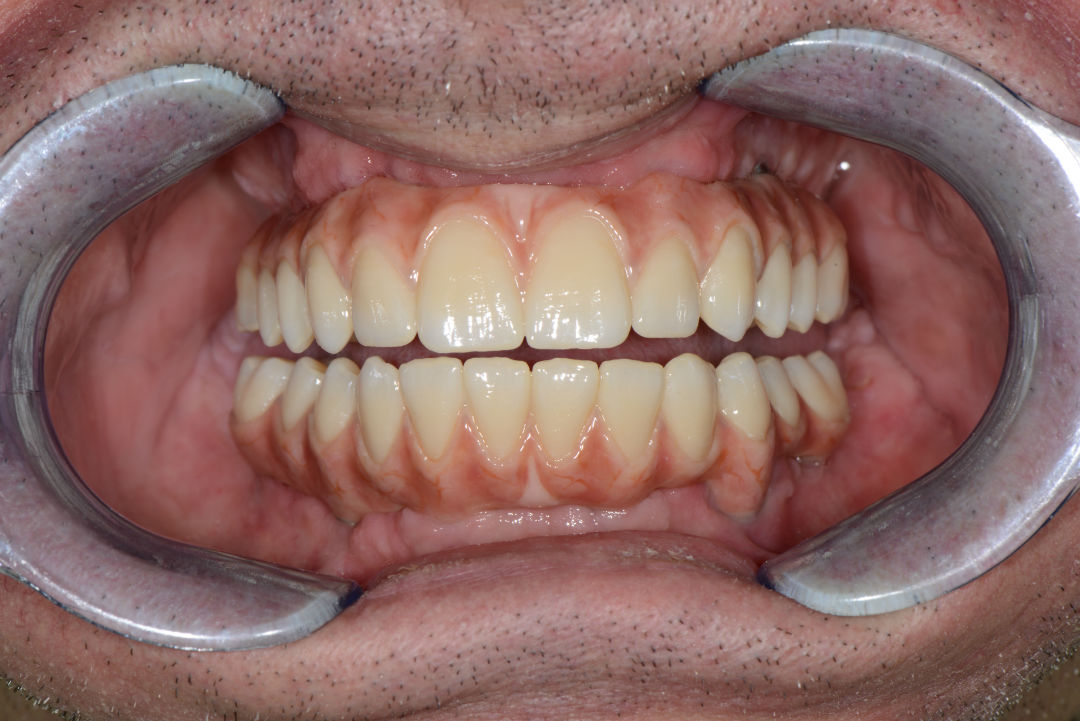
In recent years, the All-on-4 method created by Paulo Malo has gained wide popularity, due to the rapid restoration of the entire dentition with the inevitable need to remove all the remaining natural teeth, without using methods that require a longer period of time to complete the entire treatment – sinus lift, bone augmentation, etc.
For the implementation of this method, Malo and a team of engineers of the world’s largest company for the production of dental implants, Noble Biocare, developed special dental implants – Noble Speedy. The specific features of these implants are unique and provide an opportunity to improve the healing process both in the surgical phase and also in the prosthetic phase.
A large part of the other companies producing dental implants strive to adapt their implants to the original All-on-4 methodology, but their implants do not have the characteristics of the Nobel Biocare – Nobel Speedy implants in many of their indicators. Dentists who use them take the risk of early or late problems with the entire healing process. This is not in the interest of the patients themselves, because it is necessary to know that the treatment itself can be carried out only once. A second attempt to repeat the operation is very unlikely, due to the small volume of bone remaining. People should know that the removal of an osseointegrated implant is far from harmless. Very often it is also associated with the removal of large volumes of bone, which can subsequently be very difficult to restore, if at all possible.
For people, an important point is the final price of a treatment, but very often cheap dental implants are used by dentists to increase the turnover of placed implants and make more profit. All this increases the risk that the patient will suffer with the appearance of many problems over time. The biggest problem is the refusal of other dentists to help him, especially when so-called basal implants are used. These people are very often forced to seek very expensive help abroad.
Now we will pay special attention to the Nobel Speedy implants, with which the treatment is carried out according to Palo Malo’s All-on-4 concept.
Nobel Speedy implants and the All-on-4 concept are trademarks of Nobel Biocare. What distinguishes Nobel Speedy implants from other types of dental implants?
1. In terms of surgery, it is important that Nobel dental implants are not cutting, but stretching. In thin bone, this allows the implants themselves to be used as expanders in relation to the cortical walls of the existing thin bone.
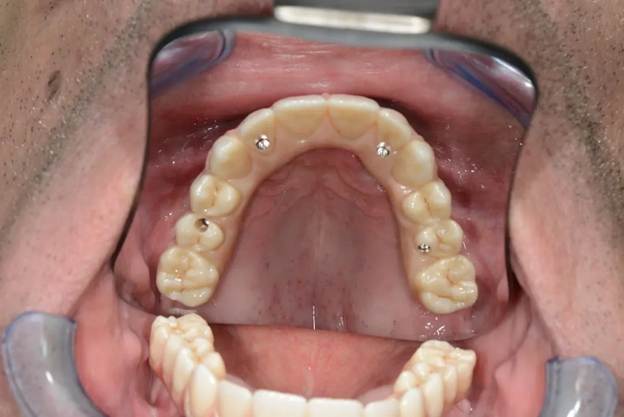
2. Regarding prosthetics /teeth on dental implants/ it is necessary that the holes through which the fastening screws pass are located in the central fissure of the teeth. This is achieved through the so-called Multi unit. Nobel speedy implants have an outer hexagon in the upper part. A multy unit can be attached to it in 18 possible positions. This gives the dentist a great opportunity to position the multy unit relative to the implant so that the holes on the chewing surface of the teeth are exactly in the chewing groove. In comparison, with all other implants the possible positions are 6 in an internal hexagon. This means that with Nobel speedy, the probability of early positioning is three times greater. This accuracy can be crucial to the outcome of the final All-on-4 treatment.
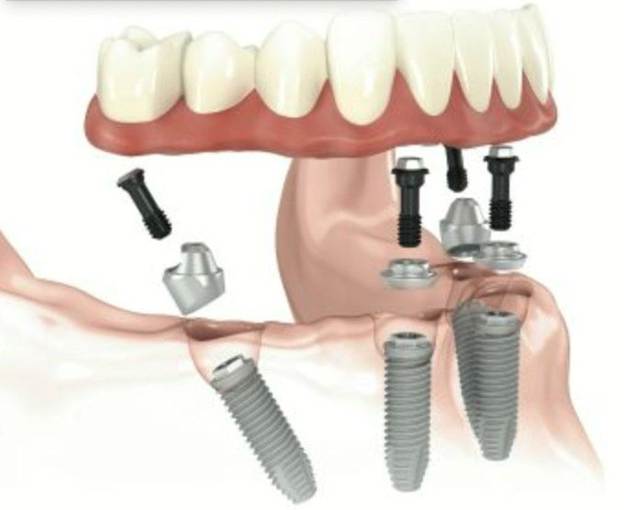
A few words about the All-on-4 concept.
With her, already on the 1st day of placement of 4 implants, you leave with a stable, temporary, fixed bridge of 10 teeth – screw-fixed. This can happen in two situations:
1. When you have a full or partial removable prosthesis and want to part with it for one reason or another.
2. When your teeth need to be extracted.
In both situations, you will not be without teeth for a single day.
With All-on-4, so far unsolvable situations can be solved in the most elegant way possible – without a sinus lift and bone replacement grafts. The risks, time and final cost of treatment compared to these methods are reduced.
The treatment is completed with a permanent bridge of 12 teeth using modern zirconia CAD / CAM technology in our dental laboratory. What is CAD / CAM in a nutshell. With this technological methodology, the prosthetic structure (the dental bridge) is made by scanning the model, computer design and cutting it on a special lathe – milling machine made of zirconia.
The number of 4 implants is not a guarantee of quality and reliability of the treatment when using unsuitable implants / including Nobel /. You may be unpleasantly surprised if implants of other companies are used in an attempt to lower the final price of treatment according to this concept.
The modern world trend is to use fewer implants, on which to place at least 12 teeth.
For you in the last two years, Dr. Marinov Jr. developed and perfected the digital methodology for the application of the Surgical Guides in accordance with the Malo method – All-on-4.
This is the guarantee of extremely accurate positioning of the distal – posterior dental implants relative to the maxillary sinuses in the upper jaw and the mandibular canal of n. mandibularis in the lower jaw during the surgical operation.
The second modern development of Dr. Marinov Jr. is a digital scan during the operation itself, which is not easy at all. It allows us, under certain circumstances, to shorten the clinical visit to determine the height of occlusion and the central position of the mandible without changing the biometric parameters of the facial skeleton.
Dr. Marinov Jr. and Dr. Duchev are the only Bulgarian dentists who took the trouble, invested money and time to attend Prof. Malo’s courses in Lisbon in order to “get knowledge from the source” and treat you with dental implants according to the original All-on-4 methodology.
The moments shared with you to restore your dentition with dental implants according to the original methodology of Paulo Malo – All-on-4 are part of real, modern dentistry, which is practiced in the Denta Consult clinic.